Permanent Magnet Synchronous Motor (PMSM) controllers play a critical role in modern motion control systems, enabling precise, efficient and reliable operation across a wide range of industrial and commercial applications. From automation and robotics to electric vehicles and pumps, PMSM motor controllers are increasingly the preferred choice where performance, efficiency and controllability matter.
This guide explains what a permanent magnet synchronous motor controller is, how PMSM control works, common speed control strategies, and how to choose the right controller for your application. It is written for engineers, OEMs and technical decision makers who need both technical clarity and practical guidance when specifying motor control solutions.

What Is a Permanent Magnet Synchronous Motor (PMSM)?
A Permanent Magnet Synchronous Motor (PMSM) is an AC motor that uses permanent magnets embedded in or mounted on the rotor to generate its magnetic field. Unlike induction motors, the rotor of a PMSM rotates synchronously with the stator’s rotating magnetic field, meaning there is no slip between rotor speed and electrical frequency.
Key characteristics of PMSM motors
- Permanent magnet rotor – Eliminates rotor copper losses
- Synchronous operation – Precise speed control relative to supply frequency
- High efficiency – Especially at partial load
- High power density – Compact size for a given torque output
- Excellent dynamic performance – Fast response to load and speed changes
Because PMSM motors do not self-start directly from a fixed AC supply, they require an electronic controller to generate and regulate the drive waveforms. This is where the permanent magnet synchronous motor controller becomes essential.
Control of Permanent Magnet Synchronous Motors
The control of permanent magnet synchronous motors is significantly more advanced than simple voltage or frequency control used in basic motor drives. A PMSM controller actively manages current, voltage, rotor position and speed to achieve stable and efficient operation.
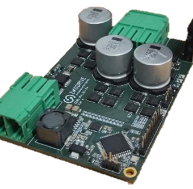
What does a PMSM motor controller do?
A PMSM motor controller performs several core functions:
- Converts DC supply power into controlled three-phase AC waveforms
- Determines rotor position (via sensors or sensorless estimation)
- Regulates torque and speed by controlling phase currents
- Protects the motor and system from faults
- Interfaces with higher-level control systems
The controller effectively acts as the “brain” of the motor system, continuously adjusting output based on feedback and commands.
Rotor position feedback
Accurate rotor position information is critical for permanent magnet synchronous motor control. Common approaches include:
- Hall effect sensors – Simple, robust, lower resolution
- Incremental encoders – Higher precision, widely used in automation
- Absolute encoders – Known position on power-up
- Sensorless control – Estimates position from back-EMF or motor models
Sensorless PMSM control is attractive for cost and reliability reasons, but can be more challenging at low speeds or high torque demand.
Speed Control in PMSM Systems
Speed control in PMSM systems is one of the main reasons these motors are widely adopted. A well-designed PMSM controller provides smooth, accurate and repeatable speed regulation across a wide operating range.
PMSM speed control methods
Several PMSM speed control methods are commonly used:
Field-Oriented Control (FOC)
Field-Oriented Control (also known as vector control) is the most widely used method for control of permanent magnet synchronous motors.
FOC works by mathematically transforming stator currents into a rotating reference frame aligned with the rotor magnetic field. This allows independent control of:
- Torque-producing current
- Flux-producing current
Benefits of FOC include:
- High efficiency
- Smooth torque with minimal ripple
- Excellent low-speed performance
- Precise dynamic response
For most modern PMSM applications, FOC is the preferred control strategy.
Scalar control (V/f)
Scalar control regulates voltage and frequency together but does not directly control torque. While simpler, it is rarely used for PMSM motors due to poor performance and efficiency compared to FOC.
Direct Torque Control (DTC)
DTC directly controls torque and flux using hysteresis controllers. It offers fast response but can produce higher torque ripple and acoustic noise, making it less common in precision PMSM applications.
Speed loops and torque loops
A typical PMSM motor controller uses nested control loops:
- Inner current loop – Fast torque response
- Speed loop – Maintains target motor speed
- Position loop (optional) – Used in servo-type systems
This layered approach allows accurate speed control even under rapidly changing loads.
Key Benefits of PMSM Controllers
Using a dedicated permanent magnet synchronous motor controller offers several advantages compared to simpler drive solutions.
High efficiency and energy savings
Because PMSM motors eliminate rotor losses and controllers precisely regulate current, overall system efficiency is significantly higher than induction or brushed DC systems.
Precise speed and torque control
Advanced PMSM control algorithms allow smooth low-speed operation, stable torque production and accurate speed regulation, even at very low RPM.
Compact and high power density
PMSM motors paired with modern controllers deliver high torque from smaller packages, enabling more compact machine designs.
Reduced maintenance
With no brushes and lower thermal stress, PMSM systems typically offer longer service life and reduced maintenance requirements.
Flexibility and integration
Modern PMSM controllers support:
- Digital communications (CAN, UART, RS485, Ethernet)
- Software configurability
- Integration with PLCs and automation systems
Applications of PMSM Motor Controllers

PMSM controller applications span many industries where performance and efficiency are critical.
Industrial automation
Used in conveyors, pumps, compressors, machine tools and production equipment where precise speed control and efficiency are required.
Robotics and motion control
Robots and automated systems benefit from the fast response, accuracy and compact size of PMSM motor controllers.
Electric vehicles and mobility
PMSM motors are widely used in EV traction systems, power steering, pumps and auxiliary drives.
HVAC and pumps
Variable-speed PMSM drives significantly reduce energy consumption in fans, blowers and pumping systems.
Medical and laboratory equipment
Quiet operation, smooth torque and precise control make PMSM systems suitable for sensitive equipment.
How to Choose the Right PMSM Controller
Selecting the right PMSM motor controller requires balancing electrical, mechanical and application-specific requirements.
Key selection criteria
Motor parameters
Ensure the controller supports:
- Rated voltage and current
- Motor power and torque
- Number of pole pairs
- Feedback device compatibility
Control requirements
Consider:
- Speed range
- Torque accuracy
- Low-speed performance
- Dynamic response
Feedback and sensing
Decide whether your application requires:
- Hall sensors
- Encoders
- Sensorless operation
Environmental and mechanical factors
- Operating temperature
- Cooling requirements
- IP rating
- Mounting constraints
Communications and integration
Check compatibility with:
- Control networks
- Existing PLC or HMI systems
- Configuration and diagnostic tools
Custom vs off-the-shelf controllers
Off-the-shelf PMSM controllers suit many standard applications. However, custom or configurable solutions are often preferred when:
- Motors are non-standard
- Space is constrained
- Application-specific safety or performance features are required
PMSM Controllers vs Other Motor Control Solutions
Understanding how PMSM controllers compare to alternatives helps justify the investment.
PMSM vs Induction Motor Controllers
| Feature | PMSM | Induction |
|---|---|---|
| Efficiency | Very high | Moderate |
| Low-speed torque | Excellent | Limited |
| Control complexity | Higher | Lower |
| Power density | High | Lower |
PMSM vs Brushed DC Motor Controllers
While brushed DC motors offer simple speed control, PMSM systems outperform them in efficiency, reliability and lifetime, making PMSM controllers a better long-term solution.
Speak to Zikodrive About PMSM Motors & Custom Options
Choosing the right permanent magnet synchronous motor controller is critical to achieving reliable performance, efficiency and long-term value. At Zikodrive, we specialise in optimised motor control solutions, offering PMSM controllers and motor systems designed to meet demanding real-world applications.
Whether you are developing new equipment, upgrading an existing system or looking for a custom motor control solution, our team can support you with:
- PMSM motor and controller selection
- Application-specific control strategies
- Custom firmware and integration support
- Scalable solutions for OEMs
Speak to Zikodrive today to discuss your PMSM motor control requirements and explore how our expertise can help you deliver efficient, reliable and high-performance motion systems.